I've Been A Geriatric Specialist For 25 Years. Here's What I Tell Every Patient Who Says "It's Just My Age."


The most common thing I hear in my clinic is also the most damaging thing a person can believe about their own body.

Dr. Stephanie Baker, M.D.

Tailbone pain · Hip stiffness · Lower back ache · Sciatic discomfort · Can't sit through a full visit

4.9/5 Rating | 12,000+ Reviews

Most chronic sitting pain in older adults isn't an aging problem. It's a pressure problem.

And the difference between those two things determines whether you spend the rest of your life managing it — or fixing it.

My name is Dr. Stephanie Baker. I specialize in geriatric medicine — the health and quality of life of adults over 60. I've spent 25 years watching what happens to people who accept pain as inevitable. And I've spent just as long watching what happens to the ones who don't.

The ones who keep driving themselves to church. Who stay for the whole family dinner. Who take the long trip to see the grandkids without planning their stops around the pain.

They didn't get lucky. They understood something the others didn't.

Sitting didn't get more uncomfortable because they got older. It got more uncomfortable because of a specific physical change — one that has nothing to do with age, and everything to do with mechanics.

That's what I want to explain to you today. Because once you understand what actually changed, the solution becomes obvious.

One of my patients — I'll call her Margaret — came in at 71 for a routine checkup.

She didn't mention the pain. She never mentioned it. In the two years I'd been seeing her, she'd never once complained about her back, her hips, or her tailbone.

I only found out because I asked about her Sunday routine. She told me she'd been leaving church early. That the long drive to her daughter's house now needed two stops. That she'd started choosing seats at the restaurant by how quickly she could stand up again.

When I pressed her on it, she said something I've heard dozens of times: "I thought it was just my age. My mother had the same thing."

She wasn't wrong that her mother had it. She was wrong about why.

I ran through the physiology with her. As we age, subcutaneous fat tissue in the gluteal region decreases measurably. Skin becomes thinner. The natural cushioning the body provides when sitting on a hard surface — the padding your body built for you — diminishes. The same chair you sat in for ten years starts to feel different, not because the chair changed, but because your body's natural buffer did.

Margaret hadn't failed. Her body hadn't failed. The seat had simply stopped having the support underneath it that her body used to provide.

She looked at me and said: "So it's not my fault?"

It was never her fault. It was physics.

And physics, unlike aging, can be solved.

Here's what I've watched happen, consistently, when people accept sitting pain as inevitable.

It doesn't stay the same. It progresses. Not dramatically — quietly. One activity at a time.

Stage 1 — "It's nothing"

The church pew gets uncomfortable around the 40-minute mark. You shift position. You tell yourself it's the hard wood. You stay for the whole service, but you're counting hymns by the end.

Stage 2 — The first adjustment

You start picking the aisle seat. Not for convenience — for the exit. You leave family dinners a little earlier than you want to. You stop mentioning it, because you don't want to be the one who needs to leave.

The drive to your daughter's house, which used to be easy, now needs a stop you didn't used to take. You don't tell her why.

Stage 3 — The quiet no

You start saying no before anyone asks. The restaurant with the hard chairs — "let's just eat here." The grandchild's school performance — you go, but you find the seat closest to the back so you can stand without being seen. The long family road trip — you wonder if someone else should drive.

You don't announce any of this. You just quietly rearrange your life around the sitting.

Stage 4 — The chair at home

Your recliner — the one place that used to be completely yours, the place you ended every day — starts to hurt too. You shift more. You get up earlier than you want to. You watch less television, not because you're tired, but because sitting itself has become work.

"I thought I was just old now."

That sentence — those exact words — is what I hear right before I explain what I'm about to explain to you.

Stage 5 — What the body is telling you

Prolonged unrelieved pressure on the coccyx and surrounding tissue isn't just uncomfortable. Over time, it creates chronic coccydynia — persistent tailbone pain that doesn't resolve on its own. It compresses the sciatic nerve, creating the burning, radiating sensation that runs down the leg. And it creates pressure on tissue that, in older adults with thinner skin and less subcutaneous fat, is more vulnerable than it was twenty years ago.

None of this is inevitable. All of it is mechanical. And mechanical problems have mechanical solutions.

Let me show you what this is actually costing you.

Not in medical expenses — though those matter too. In something you can't get back.

Every family visit you shorten costs you time with the people you love most. If you cut a visit by an hour because the sitting gets hard — and you do this once a week — that's 52 hours a year. Over five years, that's more than ten full days of time with your grandchildren, your children, your friends that you didn't have to lose.

Every church service you leave early. Every dinner you skip because the chairs aren't worth it. Every trip you don't take because the drive is too long now.

None of that shows up on a medical bill. All of it shows up in your life.

And the financial side is real too. Most of my patients who've been dealing with this for more than a year have already spent:

$60 to $120 on foam cushions that went flat within months and had to be replaced. $80 to $150 per chiropractor visit, twice a month, for relief that lasts 48 hours and then gets undone by the next day in the same chair. $360 a year on over-the-counter pain medication that manages the symptom without touching the cause.

Sometimes a new recliner. Sometimes a new car, because they thought the seat was the problem.

None of it fixed anything. Because none of it addressed what actually changed.

You've already spent more than this cushion costs trying to solve a problem nobody explained to you correctly.

Here's why nothing you've tried has lasted.

The foam cushion from the pharmacy or Amazon

It felt supportive the first week. Maybe the first month. Then it flattened. The foam compressed under your weight and never fully recovered. By month two, you were sitting on a dense pancake that was barely thicker than nothing. You bought another one. Same result.

This is not a quality problem with any particular cushion. It is a material problem with foam itself. Foam is a continuous, compressible mass. Under repeated pressure, it deforms. That is what foam does. No density rating changes this permanently — it only changes how long it takes.

The donut cushion

Looks medical. Feels awkward. Slides around. And the hole — designed to relieve tailbone pressure — creates uneven support on the sides that often makes hip pain worse, not better. Research consistently shows that open-center designs work well in clinical settings with proper fitting and don't translate reliably to home use.

The chiropractor visits

These help. I'm not dismissing them. But they treat what the sitting did to you, not what the sitting is doing to you. You leave feeling better. You sit the same way on the same surface for another week. And the adjustment gets undone. At $80 to $150 a visit, twice a month, you're paying indefinitely to manage a problem that is recurring because the root cause — the pressure on your tailbone every time you sit — hasn't changed.

The new recliner

I've had patients buy $1,200 recliners hoping the seat would finally be right. Sometimes it helped for a few months. Then the new cushioning compressed too, because all upholstered furniture uses foam, and foam compresses. The problem followed them to the new chair.

"It's just my age. There's nothing to do."

This is the most costly of all the failed solutions, because it's the one that stops you from looking. The belief that sitting pain is an inevitable part of getting older isn't just wrong — it's specifically, measurably wrong. The pain has a physical cause. The physical cause is not aging. The physical cause is the loss of natural cushioning in the gluteal region, combined with increased pressure sensitivity from thinner skin and less subcutaneous fat. These are documented, studied, and understood. And they respond to mechanical intervention.

The pain is real. The cause is mechanical. That means it can be addressed.

Here's what actually changed — and why it matters for everything that follows.

When you were younger, your body provided its own cushioning. Subcutaneous fat in the gluteal region — the body's natural seat padding — created a buffer between your bones and whatever surface you were sitting on. This is documented in medical literature: as we age, this tissue decreases measurably. Skin becomes thinner. Elasticity reduces.

The chair didn't change. Your body's ability to protect itself from the chair did.

This is why the same seat that was fine for ten years started hurting. Not because you're weaker. Because the mechanical interface between your body and the seat changed.

Why foam can't fix this

Foam works by compression. It gives under weight and creates a softer surface. But it compresses uniformly — everywhere at once. It doesn't know where your tailbone is. It doesn't know where your sciatic nerve runs. It pushes back against everything equally, and it degrades over time.

More importantly: foam replaces the cushioning your body lost with a material that eventually stops cushioning too. It's a temporary solution with an expiration date built in.

Why the hexagonal grid is different

Bees solved this problem before humans did.

The hexagon is the strongest shape in nature for distributing weight across a surface. Each cell carries load independently. When pressure is applied to one cell, it compresses — but the cells beside it don't. They remain firm, providing lateral stability while the loaded cell absorbs what's directly above it.

This is not a design metaphor. This is the actual mechanical principle behind the Axis Grid™.

The hexagonal cells inside this cushion work the same way. Only the cells directly beneath your sit bones and tailbone compress. The surrounding cells stay firm. This means your pelvis is supported — not sinking. Your tailbone is relieved — not bearing the full load of your upper body. And the structure doesn't degrade the way foam does, because nothing is compressing uniformly. Each cell returns to its original shape after pressure is released.

The result, in the words of someone who tried it: "You feel like you're being held up on something, not just sinking."

That's not marketing language. That's a customer describing exactly what Isolated-Cell Support — the principle behind the Axis Grid™ — actually does.

What this means for your body specifically

For an older adult who has lost natural gluteal cushioning, the Axis Grid™ doesn't just make sitting more comfortable. It replaces — mechanically — the buffer your body used to provide naturally. The cells under your tailbone relieve the chronic pressure that creates coccydynia. The cells under your sit bones distribute weight across a larger area, reducing the concentrated load on skin and tissue that is more sensitive than it was twenty years ago.

It's not a seat cushion. It's a mechanical replacement for something your body stopped doing on its own.

"The loss of subcutaneous fat tissue in the gluteal region is one of the most consistently underestimated contributors to sitting pain in older adults. Most of my patients who report worsening discomfort over time are experiencing exactly this — not spinal deterioration, not muscular weakness, but the loss of the body's own pressure-relief system.

The hexagonal grid structure in the Axis Grid™ addresses this mechanically in a way that foam-based products cannot. Each cell responds independently to pressure, which means the cushion adapts to individual anatomy rather than simply compressing under weight. For my patients who want to maintain their independence, stay active, and continue doing the things that matter to them — church, family visits, long drives, evenings in their favorite chair — this is the first product I've recommended with confidence that the mechanism is right.

The design is also appropriate for older adults specifically: it doesn't look like a medical device. It doesn't signal disability or need. It sits on any chair, in any setting, and does its job without announcing itself."

— Dr. Stephanie Baker, M.D.

Three systems. One cushion. Built specifically for the body that's been sitting for six decades.

SYSTEM 1 — Isolated-Cell Support (Axis Grid™)

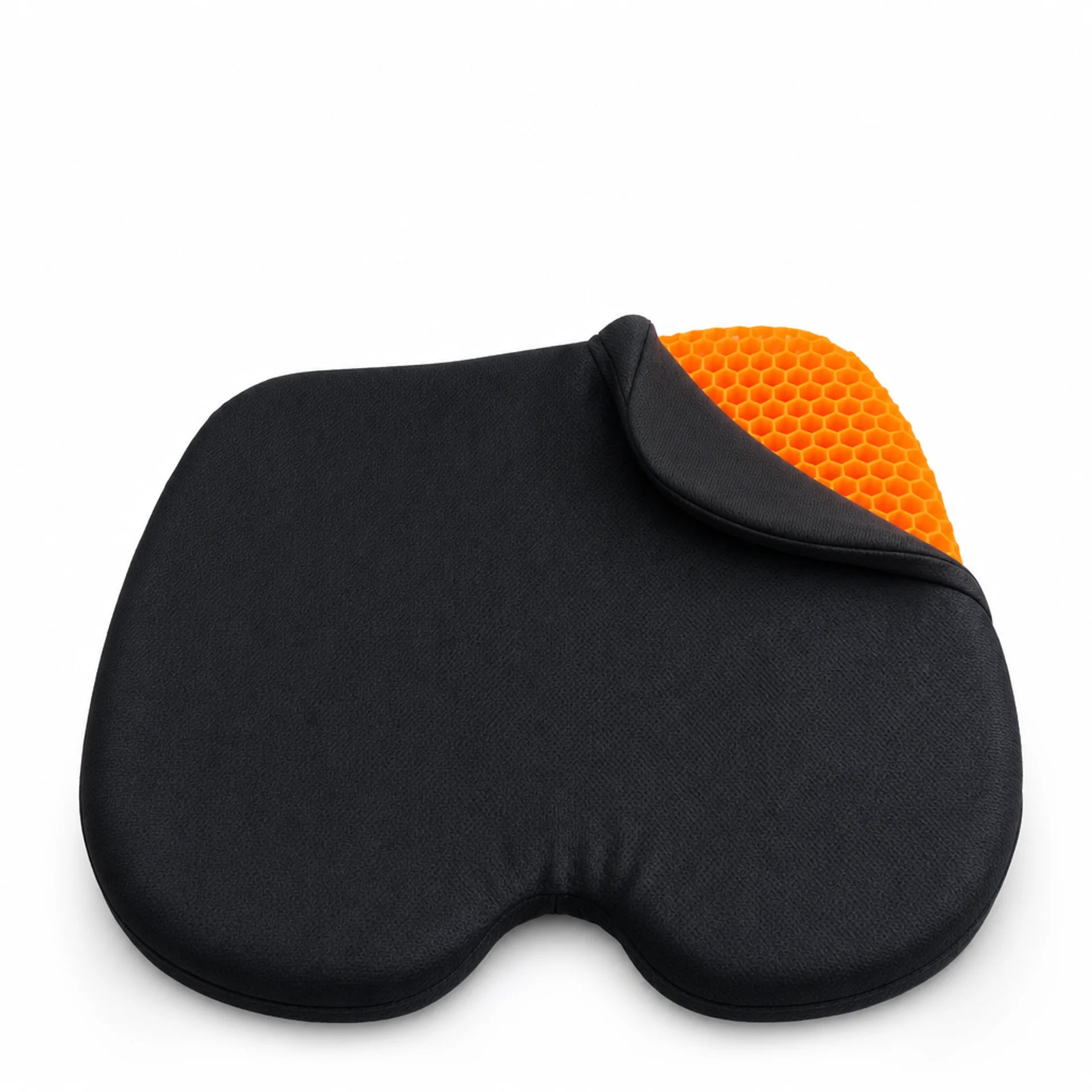
The hexagonal grid inside every Axis Grid™ cushion operates on the same structural principle bees have used for millions of years. Only the cells directly under your body compress. Surrounding cells stay firm. This means your tailbone is relieved, your sit bones are distributed, and the structure returns to its original shape after every use. No compression fatigue. No flat spots. No expiration date built into the material.

SYSTEM 2 — Natural Cushion Replacement Zone

The rear section of the cushion is specifically shaped to relieve the area where most older adults carry concentrated pressure — the tailbone and surrounding tissue. This isn't a cutout that leaves you unsupported. It's a contoured zone that redistributes load away from bone and onto the broader surface area around it. Designed for the body that has less natural padding than it used to, not for the body of a 35-year-old office worker.

SYSTEM 3 — Dignity Cover

The Axis Grid™ cushion ships with a smooth black fabric cover. The orange honeycomb grid is inside — it does the mechanical work invisibly. What anyone sees is a clean, modern seat cushion that belongs in a living room, a car, a restaurant, a church pew. It doesn't look like a medical device. It doesn't signal that you need it. You bring it where you need it, and no one knows what's underneath unless you tell them.

What Real Customers Are Saying

M
Maria T.
Verified Customer

"You feel like you're being held up on something, not just sinking."

D
David K.
68 - Verified Customer

"After losing a lot of weight, I lost my natural cushion. This gave it back."

S
Sarah M.
72 - Verified Customer

"It doesn't look like a medical device. That matters to me."

S
Sarah M.
Verified Buyer - 2 days ago

"I tried a bunch of cushions without any success. This is the first one I'm not returning."

One purchase. One explanation. One solution that doesn't expire.

The honest math

You've already been paying for this problem.
You just haven't been calling it that.


Most people I talk to have already spent more than the cost of this cushion — just trying to manage a problem nobody explained to them correctly.
What you've spent trying to fix it Typical cost
Foam cushions that went flat — 2 to 4 over the years $40 – $120
Chiropractor visits, twice a month, to manage the pain $1,920 – $3,600 / year
Over-the-counter pain medication, monthly $360 / year
New recliner or chair, hoping it would help $800 – $2,000
Total spent managing a problem nobody explained correctly $3,000 – $6,000+
Axis Grid™ Seat Cushion One time
Addresses the actual mechanical cause · Lifetime No-Sag Guarantee
$69.90

One purchase. One explanation. One solution that doesn't expire.

Choose what works for you

One cushion changes everything.
Two covers every place you sit.


Most people who order one come back for a second — one for home, one for the car. Pick wherever makes sense to start.

Every cushion includes the Axis Grid™ insert, black dignity cover, spare cover, free shipping, and your Lifetime No-Sag Guarantee.

1 Cushion
For the chair where you sit the most — your recliner, dining chair, or car seat.
$69.90
one time · free shipping
Every cushion includes
  • Axis Grid™ honeycomb insert
  • Black dignity cover
  • Spare replacement cover
  • Free shipping to your door
  • Lifetime No-Sag Guarantee
  • 30-day full refund
Order Now — Free Shipping →
Free Shipping 30-Day Returns Lifetime Guarantee
Our promise to you
Lifetime No-Sag Guarantee

If it ever goes flat,
we replace it. Free. Forever.

Here is the only promise that matters after you have been through three foam cushions that all went flat:

If the Axis Grid™ ever loses its shape — ever stops providing the support it provides today — we replace it at no cost to you. No form to fill out. No deadline. No questions about how you used it or how long you've had it.

That is what lifetime means.

We offer this because the hexagonal grid structure is not foam. It does not compress permanently. Each cell returns to its original shape. We have never had to replace one for sagging — but the guarantee exists because after everything you have tried, you deserve to know we are serious before you spend another dollar.

🔄

30-Day Full Refund — No Questions

Take it home. Put it on your chair. Bring it to church. Take it in the car. If after 30 days it has not changed how sitting feels — email us and we will send your money back. You do not need to explain. You do not need to repackage it perfectly.

We would rather you have the money back than own something that did not help. That is the only position a company that believes in its product can take.

Your decision

You have two options from here.

Path 1 — Nothing changes
Keep adjusting your life around the pain.
  • The church pews don't get softer
  • The family visits don't get longer
  • The drive doesn't get easier
  • You keep leaving early
  • You keep saying no to things you want to say yes to
  • You keep telling yourself it's just age
Path 2 — One decision
$69.90. Once. The chair starts working again.
  • You sit through the whole service
  • You stay until the grandkids go to bed
  • You make the drive without planning stops
  • You stay for dinner — all of it
  • Your evening chair feels like it used to
  • Lifetime guarantee. 30-day refund. Nothing to lose.
Get the Axis Grid™ — Free Shipping →
30-Day Full Refund Lifetime No-Sag Guarantee Free Shipping
Questions I hear most often

Answered honestly.


Will it fit my recliner, dining chair, or car seat?

Yes. The Axis Grid™ cushion fits any standard chair, recliner, car seat, church pew, or restaurant chair. It is not sized for wheelchairs with custom clinical dimensions — for those, a seating specialist is the right resource.

I'm heavier than average. Will the grid hold up?

The hexagonal grid is structural, not compressive. It is rated for body weights up to 300 lbs and maintains its shape under that load. Higher weight does not accelerate wear the way it does with foam, because the cells distribute rather than absorb.

How long will it actually last?

Each cell in the grid returns to its original shape after pressure is released, because there is no continuous foam mass to permanently deform. This is why we offer a lifetime guarantee instead of a one-year one — we are not hedging. The material simply does not fail the way foam does.

I've bought cushions before that didn't work. Why is this different?

Because the ones that did not work were foam. Foam compresses and stays compressed — that is what foam does, regardless of the price or the brand on the label.

The Axis Grid™ is not foam. It is a hexagonal structure where each cell operates independently. If you want proof before you believe it, that is exactly what the 30-day full refund and the lifetime no-sag guarantee are for. Try it for a month. If it does not hold up, you get your money back with no questions asked.

Does it look like a medical device or a nursing home product?

No. Black cover, clean design, no straps, no clinical branding, no beige. It looks like something that belongs on a chair — because it does. The orange grid is inside. The outside is a cushion. Nobody needs to know what is underneath unless you tell them.

Can I take it with me — to church, restaurants, the car?

Yes. It is light, there is no frame or attachment mechanism, and it fits flat in any bag. Church, restaurant, car, plane, family visit — it goes where you go. Most customers who travel with it end up ordering a second one so they do not have to move it between the car and the chair at home.

What happens if I want to return it?

Email us within 30 days and we will sort it — a return label or a direct refund, whichever you prefer. No forms. No restocking fee. No explanation required. You do not even need to repackage it perfectly.

We would rather you have the money back than own something that did not help.

A final note From Dr. Patricia Wells, M.D.
P.S.

Sitting didn't get harder because you got older. It got harder because your body's natural cushioning decreased — that is documented physiology, not inevitability. The Axis Grid™ replaces that cushioning mechanically. That is the whole story. Everything else on this page is just explaining why.

P.P.S.

You have probably already spent $100 or more on foam cushions that went flat. The Lifetime No-Sag Guarantee exists because we know that is the first thing you are thinking about. If this one ever goes flat — we send you a new one. Free. That is the promise, and it does not expire.

P.P.P.S.

30 days. Take it to church. Take it in the car. Take it to the next family dinner. If it does not change how sitting feels — full refund, no questions. You have nothing to lose except the habit of leaving earlier than you want to.

👩‍⚕️
— Dr. Stephanie Baker, M.D. Geriatric Medicine Specialist · 25 Years Clinical Practice
Order Now — Free Shipping →

30-Day Full Refund  ·  Lifetime No-Sag Guarantee  ·  Free Shipping